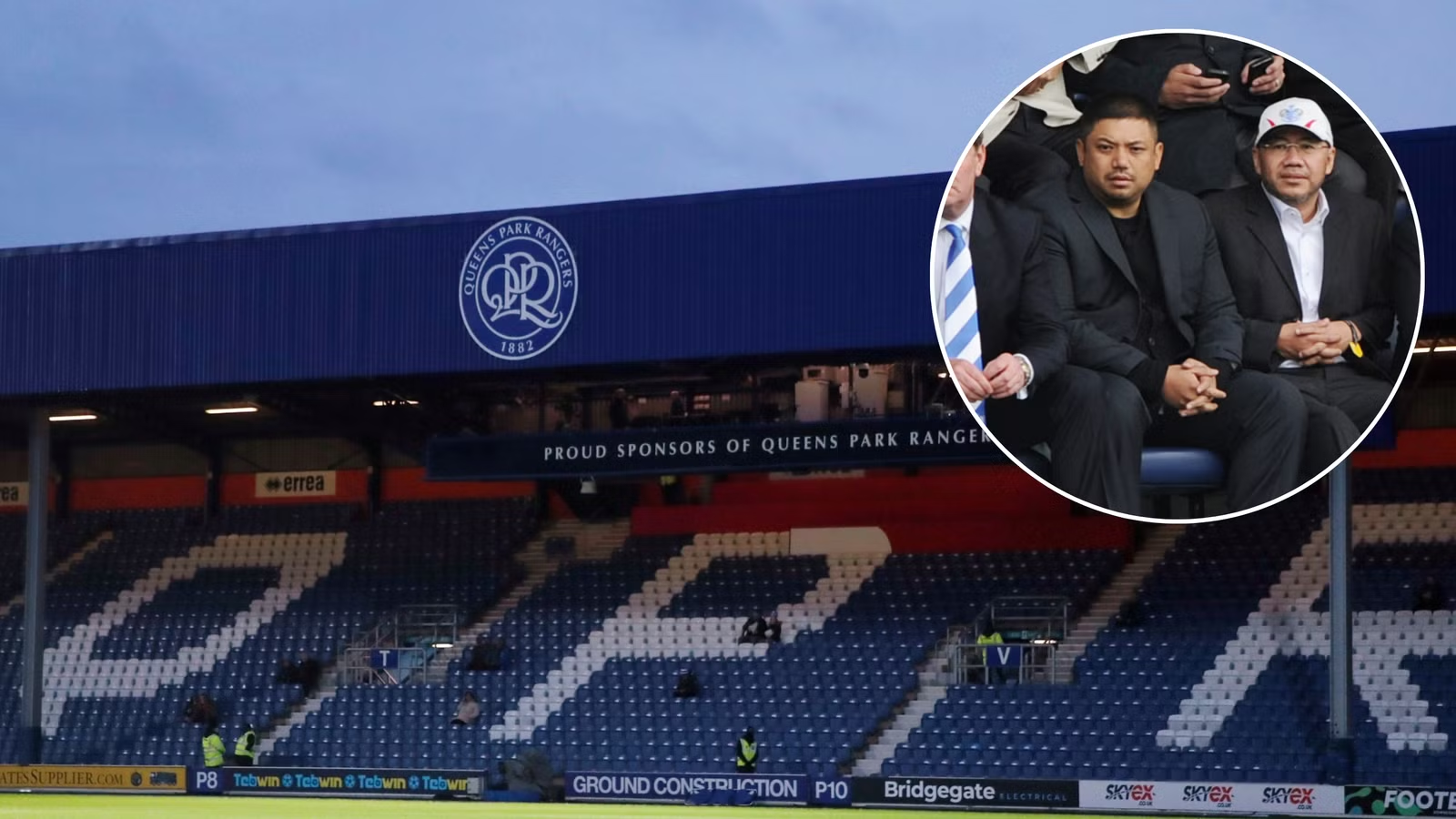
A new takeover update has been released regarding Queens Park Rangers’ majority shareholder Ruben Gnanalingam.
Ruben Gnanalingam, a Malaysian businessman, is the principal stakeholder and co-owner of Queens Park Rangers. Away from football, he is the chief executive of Westports Malaysia, one of South-east Asia’s leading port operators, and has played an important part in the family business for the previous two decades.
Gnanalingam initially became connected with QPR when Tony Fernandes’ consortium seized control of the club in 2011. He soon established himself as a prominent figure behind the scenes and was named co-chairman in 2015, as the club sought to rebuild after being relegated from the Premier League.
The team has not returned since, with 2026/27 marking its 12th consecutive season at this level. Fans will expect to see some ambition this summer, especially now that the play-offs have been enlarged to six from four. Gnanalingam has contributed to the development of a dynamic and young attacking lineup.
QPR owner Ruben Gnanalingam makes the multi-club strategy a reality.
While Fernandes was once the largest stakeholder, Gnanalingam raised his shareholding in 2016 and is now QPR’s dominant shareholder. According to the BBC, by 2021, he had been publicly named as the club’s largest shareholder and one of the driving forces behind key initiatives such as a new stadium and the expansion of the club’s training facilities.
As a result, Gnanalingam has effectively been QPR’s majority shareholder for nearly a decade and remains one of the most influential figures shaping the club’s long-term strategy, with a particular emphasis on sustainability and infrastructure to achieve gradual growth rather than short-term spending.
It appears that he now has enormous ideas, as West London Sport details QPR’s multi-club intentions. According to the report, Gnanalingam and Rangers chairman Lee Hoos have long supported the multi-club ownership concept.
He is already involved in US soccer, co-owning Los Angeles FC and QPR. Not only that, but Gnanalingam has since completed the acquisition of Australian club Central Coast Mariners. His Total Soccer Growth Holdings has seized control of both the A-League club’s senior team and its academy.
According to the source, the takeover of Mariners has been considered for quite some time. Interestingly, the Hoops are still looking to expand into the Australian market, having signed Kealey Adamson from Macarthur and Jaylan Pearman, Christian Pullella, and Daniel Bennie from Perth Glory.
QPR will attempt to replicate the work of other multi-club setups.
In recent years, several other clubs, including west London rivals Chelsea and Brentford, have attempted to establish relationships with international sides. QPR’s new partnership with both LAFC and the Central Coast Mariners, facilitated by Gnanalingam’s multi-club ownership model, has the potential to yield major long-term benefits.
Manchester City and Liverpool have made it an important component of their plan, and having partner teams on two separate continents provides opportunity to share ideas. This comprises scouting networks, recruitment information, and player development paths. It has the potential to improve the identification and transfer of talent between clubs.
It can also help lower transfer costs by identifying promising players before they become well-known. The City Football Group has assisted clubs such as Manchester City, Girona, and others in sharing resources and talent, but the Red Bull model has seen players advance through clubs such as Red Bull Salzburg and RB Leipzig before reaching the highest level.
Access to various markets in Australia and North America could provide QPR with a competitive advantage in both recruitment and player trading, allowing the club to maximise resources in an increasingly competitive Championship landscape that includes parachute payment teams and a slew of ambitious ex-Premier League sides.
xz