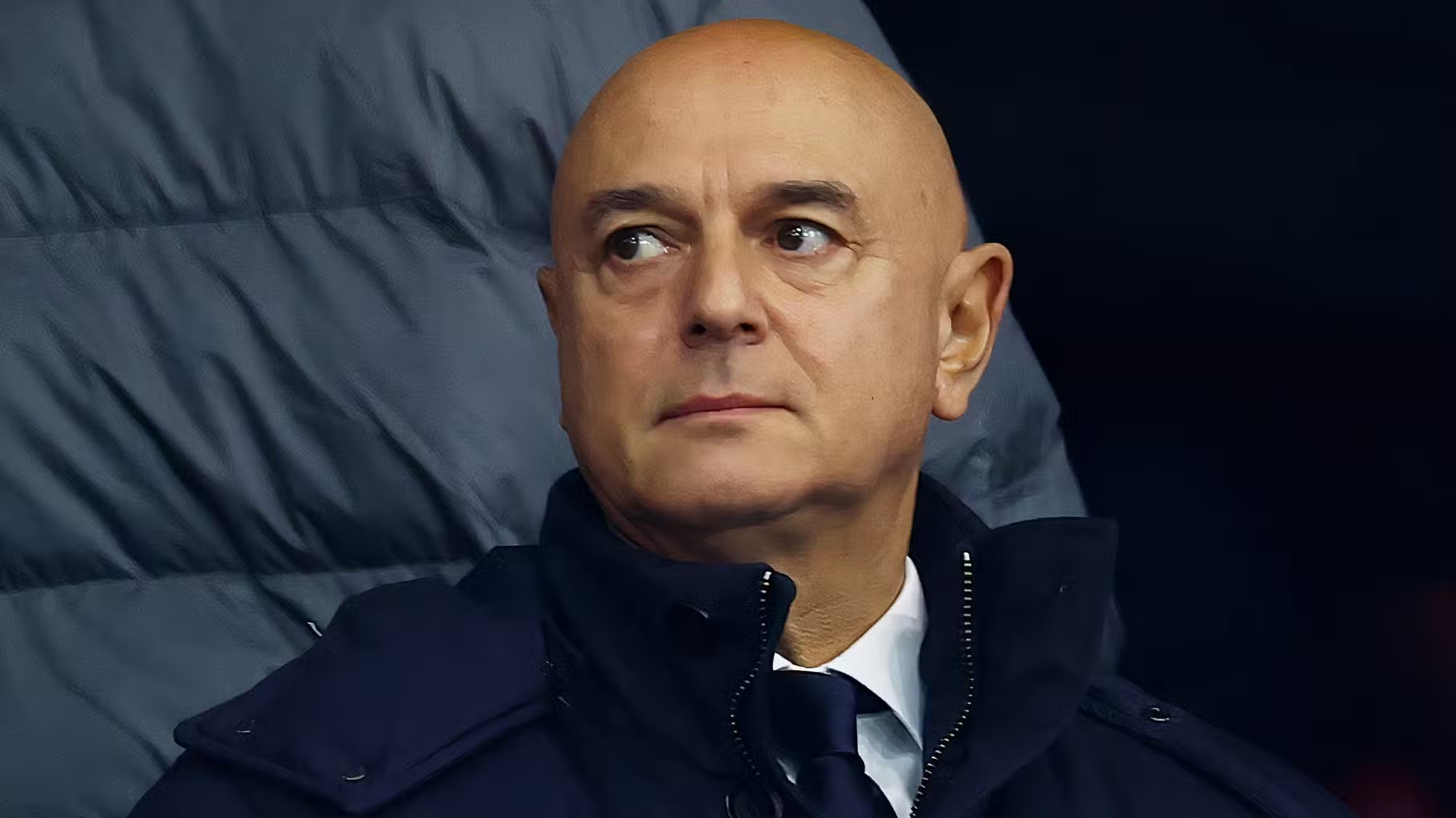
Every Premier League club’s total profit or loss during Daniel Levy’s tenure at Tottenham provides an intriguing glimpse into how successfully – or poorly – each top-flight club has been operated. Despite the fact that the now-relieved Spurs chairman’s progress stalled, he still accomplished a lot for the north London side.
Levy may legitimately claim to have “moneyballed” his way into helping the club maintain an improved financial position. He supervised the club’s transition from White Hart Lane to the state-of-the-art Tottenham Hotspur Stadium, which is considered one of the best venues in the Premier League, and presided over some of the most entertaining squads in its history.
However, when it came to getting Spurs across the finish line and into the next stage of their development, things frequently appeared to halt. Tottenham constantly appeared poised for greatness, but never quite broke through the glass ceiling, especially in the post-Pochettino era. What about the rest of the league at that time? According to The Sun, the most lucrative teams in England’s top division since 2001 include a number of surprises, as well as some clear gaffes.
How Profitable Every PL Club Has Been Over the Last 25 Years
18. Chelsea (-1.257 billion)
Chelsea’s historic deficit is unsurprising given its position at the bottom of the financial spectrum. Their lavish expenditure under both Roman Abramovich and Todd Boehly has resulted in losses of a whopping £1.257 billion, over doubling those of any other club.
This comes after they appeared three times in a list of the top ten most expensive transfer windows, with their free-spending, risk-taking mindset serving as a symbol of the Premier League’s money-driven age.
17. Aston Villa (-£706 million).
Aston Villa are surprise next with £706 million, which is most likely due to their investing much on arrivals but never being able to recoup much of that money through sells. While Jack Grealish, Jhon Duran, and Moussa Diaby gave them a lot of wiggle room, no other deals in the last 25 years have netted them £50 million or more, frequently leaving them straining to comply with PSR requirements.
16. Everton (- £589 million)
Everton has had many ownership and management changes since the 1990s, which has resulted in a lack of long-term strategy planning. This unpredictability has hampered the club’s ability to pursue consistent financial plans and achieve long-term success.
The construction of a new stadium while the team was fighting for relegation is a prime example of financial mismanagement, though their new Texas-based ownership looks to be working to undo some of the long-term collateral damage.
15. Manchester City (-£553 Million)
Since his appointment as Manchester City manager in 2016, Pep Guardiola has relished being one of the few managers who have access to a seemingly limitless reservoir of gold. His trial-and-error approach to the transfer market has seen him spend upwards of £550 million on goalkeepers and defenders alone, but he still appears to have deficiencies in those positions. This helps to explain why the Cityzens have lost £553 million over the last 25 years, and their ascent to prominence is far from a mystery.
14. Fulham (-£358 Million)
For years, Fulham fans despised its owner, Shahid Khan, and his entire family for purchasing the club in 2013 for £200 million and immediately relegating them. Going through three different managers in his first season in charge did not help to repair any damaged bridges, and things became so toxic that the club’s vice-chairman advised fans to “go to hell” on Twitter. While the football on the pitch has recently stabilized, it is apparent that Craven Cottage’s finances still require balance.
13. Manchester United (-£261 million).
Given the nightmarish cost-cutting methods Sir Jim Ratcliffe and his team have implemented at Old Trafford after acquiring over £650 million in debt following their purchase, many would expect Manchester United to rank far lower on this list.
All things considered, a £261 million loss raises concerns about whether the management misled the employees they laid off, especially since clubs deeper in the red zone aren’t experiencing the same challenges.

12. Sunderland (- £215 million)
Sunderland declared its 18th consecutive pre-tax deficit in the fiscal year 2023/24 (ending July 2024), totaling £8.6 million, despite some revenue growth and earnings from player sales.
This history of unprofitability extends back at least to 2001, with the club regarded as a “financial basket case” after decades of mismanagement, overspending, and underperformance on and off the pitch, which saw them drop all the way to League One as recently as the 2020/21 season.
11. Bournemouth (-£174 million).
While Sunderland struggled to manage their finances efficiently, Bournemouth are a prime illustration of how strong ownership can serve as a springboard to success. Eddie Howe led the Cherries to three promotions between 2009 and 2015, cementing their place in the Premier League.
Maxim Demin, a Russian businessman, purchased a 50% stake in Bournemouth in 2011, acquiring full control in 2013, and their financial backing undoubtedly played a vital influence in the club’s meteoric rise through the English football pyramid, albeit their firm has been shrewd since its inception.
10. Crystal Palace. (-£172 million)
Crystal Palace’s financial trajectory since 2001 has been punctuated by periods of acute crisis, administration, recovery, and relative stability, notably given their continued Premier League status since 2013. The club’s finances reflect a mix of ownership changes, fluctuating revenue from promotions and relegations, and strategy movements toward sustainability.
But recovery has been sweet, culminating in an FA Cup and Community Shield double this summer, with Holmesdale fans confident that they have outgrown current chairman Steve Parish.

9. Wolverhampton Wanderers (-£121 million).
Wolves are owned by Fosun International, a Chinese firm who acquired the club from long-time owner Steve Morgan in 2016. Fosun is led by three controlling businessmen, co-founders Gui Guangchang, Liang Xinjun, and Wang Qunbin, who together have an estimated net worth of about $7 billion (£5.4 billion).
During their reign, the club established itself as a Premier League stalwart, surviving in the top division since 2018 and finishing in European contention on several occasions. It’s perplexing, however, because despite their success in the 2010s and consistent sales of star players, they’re still losing more money than they’re making.
8. West Ham (-£118 million).
West Ham probably has the most complicated fan-ownership dynamic in the league. Under the contentious leadership of Sullivan, Kretinsky, and Gold, the club committed numerous mistakes. From the decision to relocate the team from their iconic Boleyn Ground to the soulless confines of the London Stadium spaceship, to the perception that the club has frequently lacked ambition, the past 15 years have not been kind to the east London side, and their finances, while not the worst, reflect this.
7. Newcastle (-£105 million).
West Ham and Newcastle both believe they belong in the top tier of the Premier League rankings. However, with the Magpies still operating below the profitability level and continually contending with the Premier League’s Profitability and Sustainability Rules (PSR), there is only so much they can do financially. Despite these restraints, Eddie Howe has continued to take them into European competition.

6. Leeds United (-£94 million).
Leeds United has played in the Premier League for only three seasons in the last 25 years. It’s no surprise that their profitability isn’t as poor as other clubs in the division, with them spending somewhat more than they can afford in a frantic attempt to stay safe.
They have progressively rebuilt from the ground up following a financial catastrophe in 2004 and administration in 2008, as seen by their plans to renovate Elland Road.
5. Nottingham Forest (minus £57 million)
Nottingham Forest is the penultimate Premier League club running at a loss. High pay from the 2023/24 season, along with a busy transfer window that saw them add an amazing 30 players over the summer, are most likely the main cause of their poor expenditure.
However, with a more cautious approach in place and now competing in Europe, they have come close to breaking even. If they continue with their current clever plan, they may be able to accomplish just that.
4. Liverpool (£19 million).
Liverpool is the only club to have won the Premier League twice in the last two decades while remaining profitable, earning £19 million in total. This is despite a summer transfer window in which they smashed the British transfer fee record twice, signing Florian Wirtz and Alexander Isak.
3. Arsenal (£72 million).
While Arsenal has not surpassed Liverpool’s successes over the last 25 years, the fact that they have remained profitable while continuously competing for the Premier League title is commendable. It makes you wonder what they could do under more free-spending ownership, like as Chelsea or Manchester City, whose managers are given nearly unlimited funds to win.
It’s also noteworthy that both the Reds and the Gunners have made significant renovations to their stadiums and training sites without breaking the bank.
2. Brighton and Hove Albion (£102 million).
Brighton excels at maximizing its existing resources. They have an excellent youth network, and the hierarchy always appears to know who to bring in when the current manager uses the south coast club as a stepping stone. Since the summer of 2022, the Seagulls have made more than £205 million in profit from player sales to Chelsea alone, with their overall profit from player sales over the last three seasons (2021-2024) being around £294 million.
1. Spurs (£167 million)
According to Kieran Maguire’s figures (which can be found in full below), Tottenham’s revenue has climbed more than tenfold under Levy, from £48 million per year when he took charge to £528 million in 2023-24. Amazingly, he accomplished this despite lowering his team’s wage-to-revenue ratio from 52% to 42%. Tottenham has regularly had the lowest ratio in the Premier League over many seasons.
xz